Building a MicroSaaS with Generative AI: How VidToPost Converts YouTube Videos into SEO-Optimized Blogs

The rise of Generative AI has created massive opportunities for developers and entrepreneurs. One of the most exciting opportunities is building MicroSaaS products—small, focused software solutions that solve a specific problem for a niche audience.
In this article, I will share my journey of building a Generative AI powered MicroSaaS product called VidToPost, a tool that automatically converts YouTube videos into SEO-optimized blog posts.
The idea is simple:
Enter a YouTube URL → Extract audio → Convert speech to text → Generate a blog → Publish to Dev.to.
The entire workflow is automated using Python, AI models, and APIs.
This project demonstrates how modern AI tools can transform content creation and help bloggers, developers, and creators save hours of manual work.
Table of Contents
The Idea Behind VidToPost
Content creators often face a common problem:
- Great knowledge exists in YouTube videos
- But written blogs are better for SEO
- Converting videos to blogs manually takes hours
For example, a 10-minute YouTube video might take:
- 20 minutes to transcribe
- 30 minutes to structure
- 30 minutes to write a blog
That is over an hour of work.
This is where Generative AI + automation becomes powerful.
VidToPost automates this entire pipeline.
The application accepts a YouTube URL and automatically:
- Extracts the audio
- Transcribes the speech
- Generates a structured blog
- Publishes it to Dev.to
The result is a production-ready blog post within minutes.
Why MicroSaaS + Generative AI Is a Powerful Combination
A MicroSaaS is a small SaaS business focused on solving one clear problem.
Instead of building large complex platforms, MicroSaaS focuses on:
- One feature
- One audience
- One workflow
Examples:
- YouTube → Blog converter
- Podcast → Newsletter generator
- Meeting → Summary generator
Generative AI makes these products extremely powerful because AI can:
- Generate content
- Understand speech
- Summarize information
- Structure data
By combining automation + AI, developers can build valuable tools quickly.
VidToPost is an example of this philosophy.
Introducing VidToPost
VidToPost is a Generative AI MicroSaaS tool that converts YouTube videos into blog posts.
The project is available here:
https://github.com/subasen85/vidtopost-devto.git
The tool is built using Python and Streamlit, making it simple and easy to deploy.
Key capabilities include:
- Downloading YouTube audio
- AI speech transcription
- Blog content generation
- Automatic publishing to Dev.to
- SEO friendly formatting
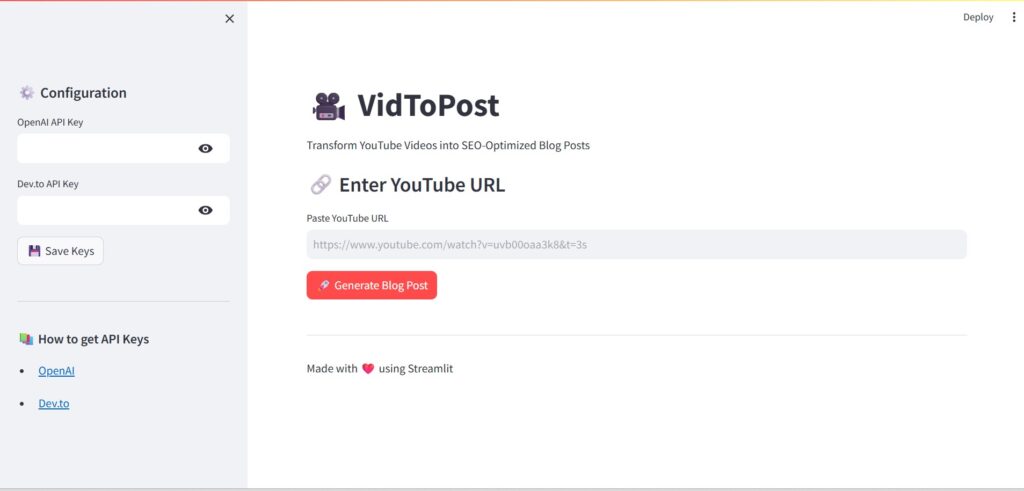
The user interface allows users to:
- Enter API keys
- Paste a YouTube URL
- Generate a blog post
The system then processes everything automatically.
Key Technologies Used
This MicroSaaS combines several modern technologies.
1. Python
Python is the core programming language powering the application.
It handles:
- API calls
- File processing
- transcription
- blog generation
- publishing workflow
Python is ideal for AI projects because of its massive ecosystem.
2. Streamlit
Streamlit is used to build the web interface.
Benefits:
- Fast UI development
- Python-only codebase
- Easy deployment
- Interactive dashboards
Users can enter:
- OpenAI API key
- Dev.to API key
- YouTube URL
Then simply click Generate Blog Post.
3. yt-dlp
yt-dlp is used to download audio from YouTube videos.
It extracts the audio stream so it can be transcribed.
Example Python usage:
import yt_dlpydl_opts = {
    'format': 'bestaudio/best',
    'outtmpl': 'audio.%(ext)s'
}with yt_dlp.YoutubeDL(ydl_opts) as ydl:
    ydl.download([youtube_url])
This step converts the video into an audio file.
4. Whisper AI
OpenAI Whisper is used for speech-to-text transcription.
It converts spoken audio into text with high accuracy.
Example code:
from openai import OpenAIclient = OpenAI()transcription = client.audio.transcriptions.create(
    model="whisper-1",
    file=open("audio.mp3", "rb")
)
This produces the raw transcript of the video.
5. Large Language Models
A Generative AI model is used to convert transcripts into structured blogs.
The AI performs tasks like:
- Summarizing
- Creating headings
- Writing paragraphs
- Generating SEO titles
- Adding tags
The result is a professional blog article.
6. Dev.to API
The final step is publishing the blog automatically to Dev.to.
Example publishing logic:
import requestsheaders = {
    "api-key": DEVTO_API_KEY
}data = {
    "article": {
        "title": title,
        "body_markdown": blog_content,
        "published": True
    }
}requests.post("https://dev.to/api/articles", json=data, headers=headers)
Once published, the blog becomes live on Dev.to.
How It Works (Complete Pipeline)
The VidToPost pipeline looks like this:
YouTube URL
      ↓
Download Audio (yt-dlp)
      ↓
Speech-to-Text (Whisper)
      ↓
Blog Generation (LLM)
      ↓
Publish to Dev.to
Each stage is automated.
Step 1: Enter API Keys
Users must enter:
- OpenAI API key
- Dev.to API key
These are saved for the current session.
Step 2: Paste YouTube URL
Example videos used in testing:
https://www.youtube.com/watch?v=uvb00oaa3k8
https://www.youtube.com/watch?v=d-NJTcTvyhw
These videos explain topics like Apache Kafka and event streaming.
The generated blog posts can be seen here:
The system also credits the original YouTube creator.
Step 3: Audio Extraction
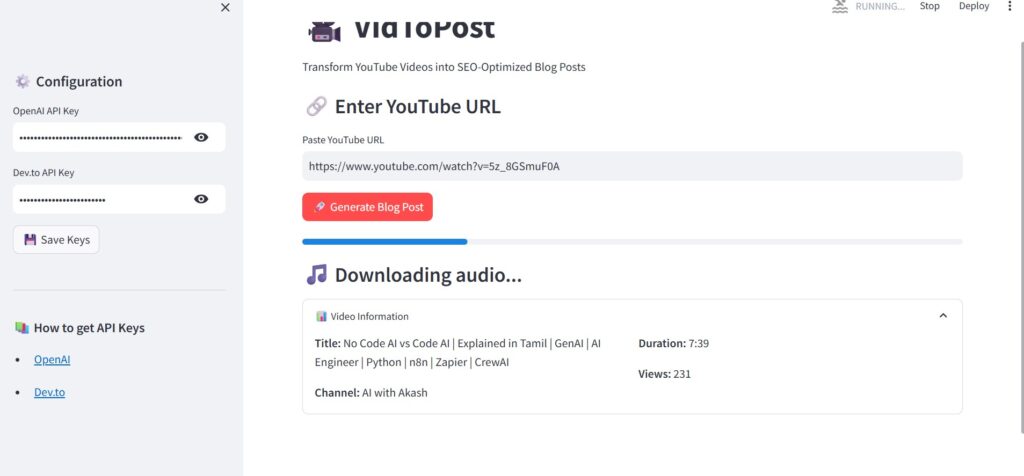
The app downloads the video audio.
Then converts it into MP3 format.
Step 4: AI Transcription
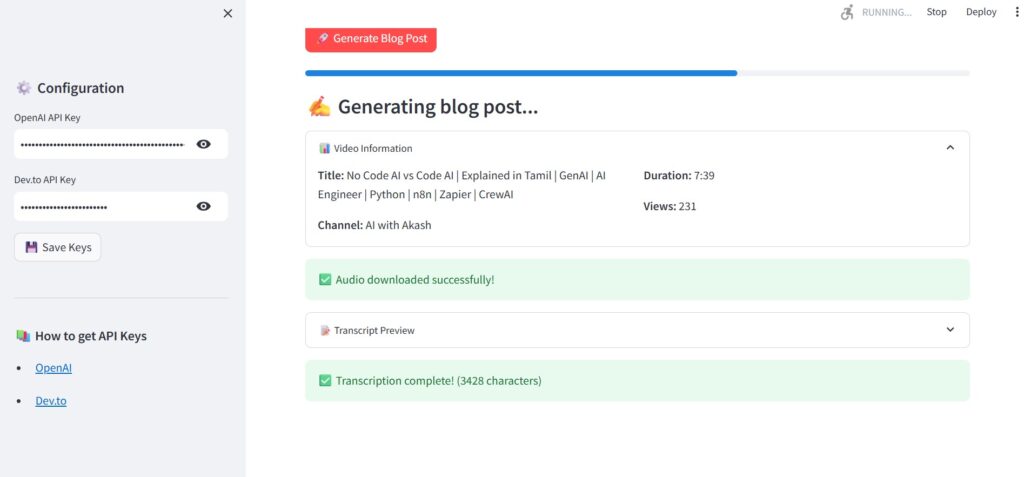
The Whisper model converts speech into text.
This produces the raw transcript.
Step 5: Blog Generation
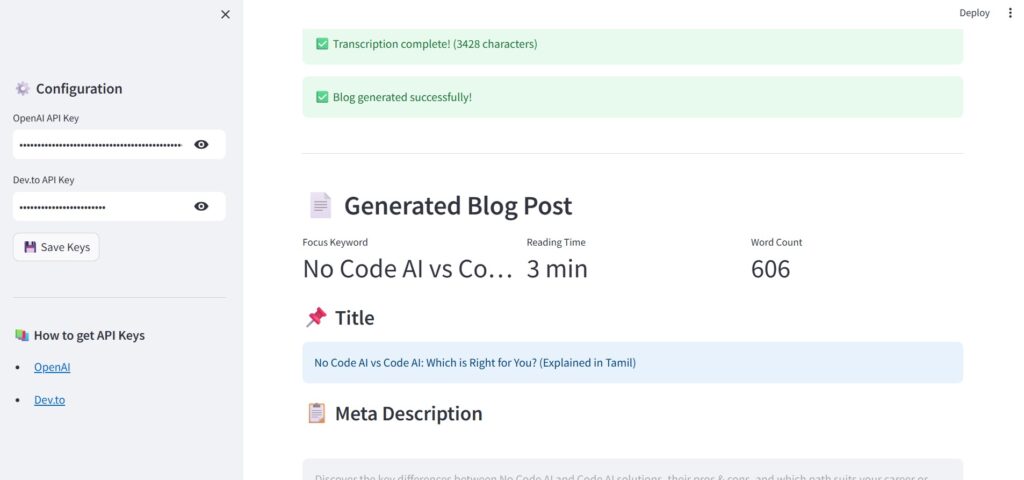
The AI converts the transcript into:
- SEO title
- Introduction
- Headings
- Structured paragraphs
- Tags
- Meta description
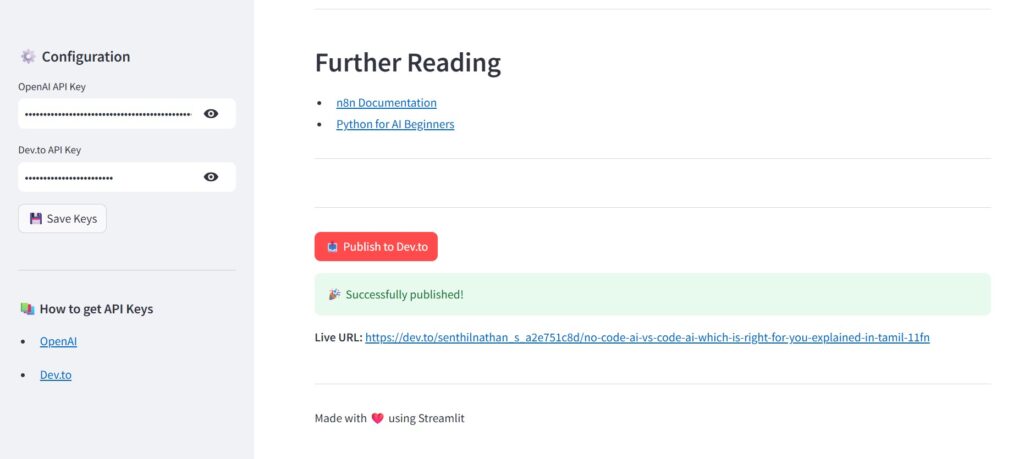
Step 6: Publishing
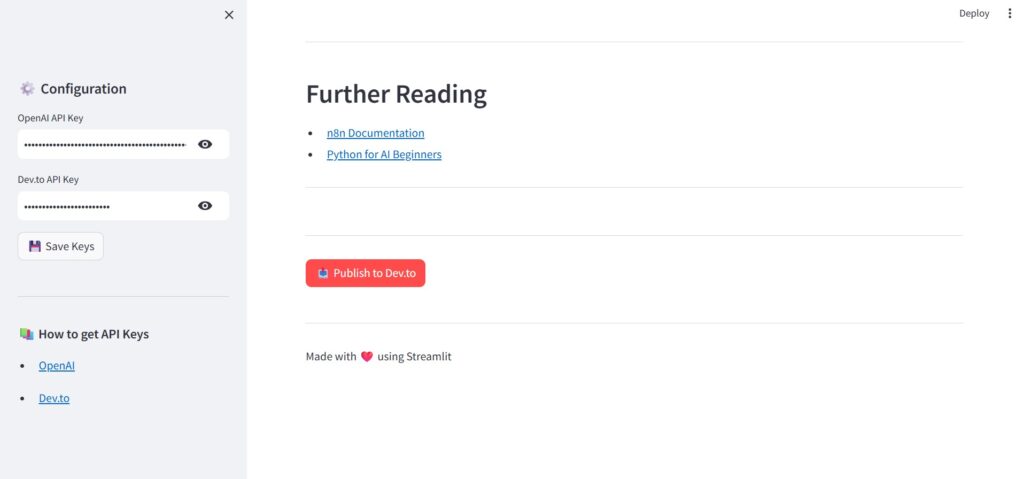
The final blog is sent to the Dev.to API.
Within seconds the article becomes live.
Example Generated Workflow
A typical video of 10 minutes produces:
- ~1500 word blog
- Structured headings
- SEO friendly content
- 5 minute read article
Processing time:
2–3 minutes
This is a huge productivity improvement.
Cost of Running the System
VidToPost is extremely affordable.
For a 10 minute video:
Whisper transcription: ~$0.06
Content generation: ~$0.10 – $0.20
Total cost:
~$0.16 – $0.26 per article
This makes the MicroSaaS very scalable.
Benefits of VidToPost
For Bloggers
- Create content faster
- Convert videos to articles
- Improve SEO visibility
For YouTubers
- Repurpose content
- Reach new audiences
- Grow blog traffic
For Developers
- Example of AI workflow automation
- Practical MicroSaaS architecture
- AI API integration
Future Improvements
VidToPost is currently an MVP.
Future improvements include:
- Batch video processing
- Image auto generation
- Medium / Hashnode publishing
- Chapter detection
- Blog templates
- User authentication
- Analytics dashboard
These features could turn VidToPost into a full MicroSaaS product.
Ethical Considerations
When converting YouTube videos to blogs, it is important to:
- Credit the original creator
- Link to the source video
- Avoid misrepresentation
VidToPost includes creator credits to respect content ownership.
Conclusion
The combination of MicroSaaS and Generative AI opens incredible opportunities.
With just a few AI tools and Python libraries, developers can build powerful products that automate complex workflows.
VidToPost demonstrates how:
- YouTube videos
- AI transcription
- LLM content generation
- API publishing
can be combined into a single automated pipeline.
What once took hours of manual effort can now be completed in minutes.
For developers exploring AI entrepreneurship, building small focused tools like VidToPost is one of the best ways to start a MicroSaaS business.
FAQ
What is a MicroSaaS?
A MicroSaaS is a small software business that focuses on solving one specific problem for a niche audience.
What does VidToPost do?
VidToPost converts YouTube videos into SEO-optimized blog posts automatically.
Which technologies are used?
- Python
- Streamlit
- yt-dlp
- OpenAI Whisper
- Large Language Models
- Dev.to API
Is the tool free to use?
The software is free, but AI APIs have small usage costs.
Can it publish blogs automatically?
Yes. The system can publish blogs directly to Dev.to using the API.
Where can I find the source code?
The project is available on GitHub:
https://github.com/subasen85/vidtopost-devto.git
If you are interested in this article or want to collaborate, feel free to get in touch.
I am available through the Contact Us page.
Thank you for reading.
Published by TechToGeek.com 🚀