
Artificial Intelligence is evolving rapidly, and one of the most exciting developments in recent years is the rise of AI Agents. Instead of using a single AI model for all tasks, developers are now building systems where multiple intelligent agents collaborate together to solve complex problems. This concept is commonly known as MultiAgent systems.
In this article, we will explore MultiAgent using LangChain, understand how it works, why developers use LangChain for agent-based architectures, and how the project structure can be treated as a chain-based workflow. We will also discuss LangChain Community Tools, LangChain Tools, architecture flow, code examples, FAQs, and practical implementation ideas.
The project reference used in this article is:
MultiAgent-Langchain GitHub Repository
Table of Contents
Introduction to LangChain
LangChain is one of the most popular frameworks used for building applications powered by Large Language Models (LLMs). It provides developers with tools to create intelligent workflows using prompts, memory, tools, agents, chains, and external integrations.
LangChain simplifies the development of AI-powered systems by offering modular components that can work together efficiently. Instead of writing everything manually, developers can combine reusable building blocks to create advanced AI applications.
Some major features of LangChain include:
- Prompt management
- Chains
- Agents
- Memory handling
- Tool integrations
- Multi-step reasoning
- Retrieval-Augmented Generation (RAG)
- Vector database support
- API integrations
LangChain is especially useful when building AI systems that need to:
- Access external tools
- Search the internet
- Use APIs
- Handle multiple reasoning steps
- Collaborate between multiple AI agents
What is a MultiAgent System?
A MultiAgent system is an architecture where multiple AI agents work together to complete tasks. Instead of relying on a single model for everything, different agents are assigned specialized responsibilities.
For example:
| Agent | Responsibility |
|---|---|
| Research Agent | Collects information |
| Coding Agent | Writes code |
| Review Agent | Validates output |
| Planning Agent | Breaks down tasks |
| Memory Agent | Stores conversation context |
This approach improves:
- Accuracy
- Scalability
- Task specialization
- Decision making
- Workflow automation
A MultiAgent architecture behaves similarly to a team of human experts collaborating together.
Why Build MultiAgent Systems Using LangChain?
LangChain is highly suitable for MultiAgent architectures because it already provides:
- Agent orchestration
- Tool calling
- Memory management
- Chain execution
- Prompt engineering utilities
- Integration support
The project discussed here can also be considered a Chain because multiple agents pass outputs from one stage to another in a sequential or collaborative workflow.
Why LangChain Was Chosen for This Project
The project uses LangChain because:
1. Modular Design
LangChain allows developers to build reusable AI components.
2. Easy Agent Management
Developers can create specialized agents with different roles.
3. Tool Integration
LangChain supports:
- APIs
- Web search
- Databases
- Python execution
- Community tools
4. Scalable Workflow
Multiple agents can collaborate dynamically.
5. Community Ecosystem
The ecosystem around LangChain is rapidly growing.
6. Faster Development
Developers can prototype AI workflows quickly.
Understanding MultiAgent using LangChain
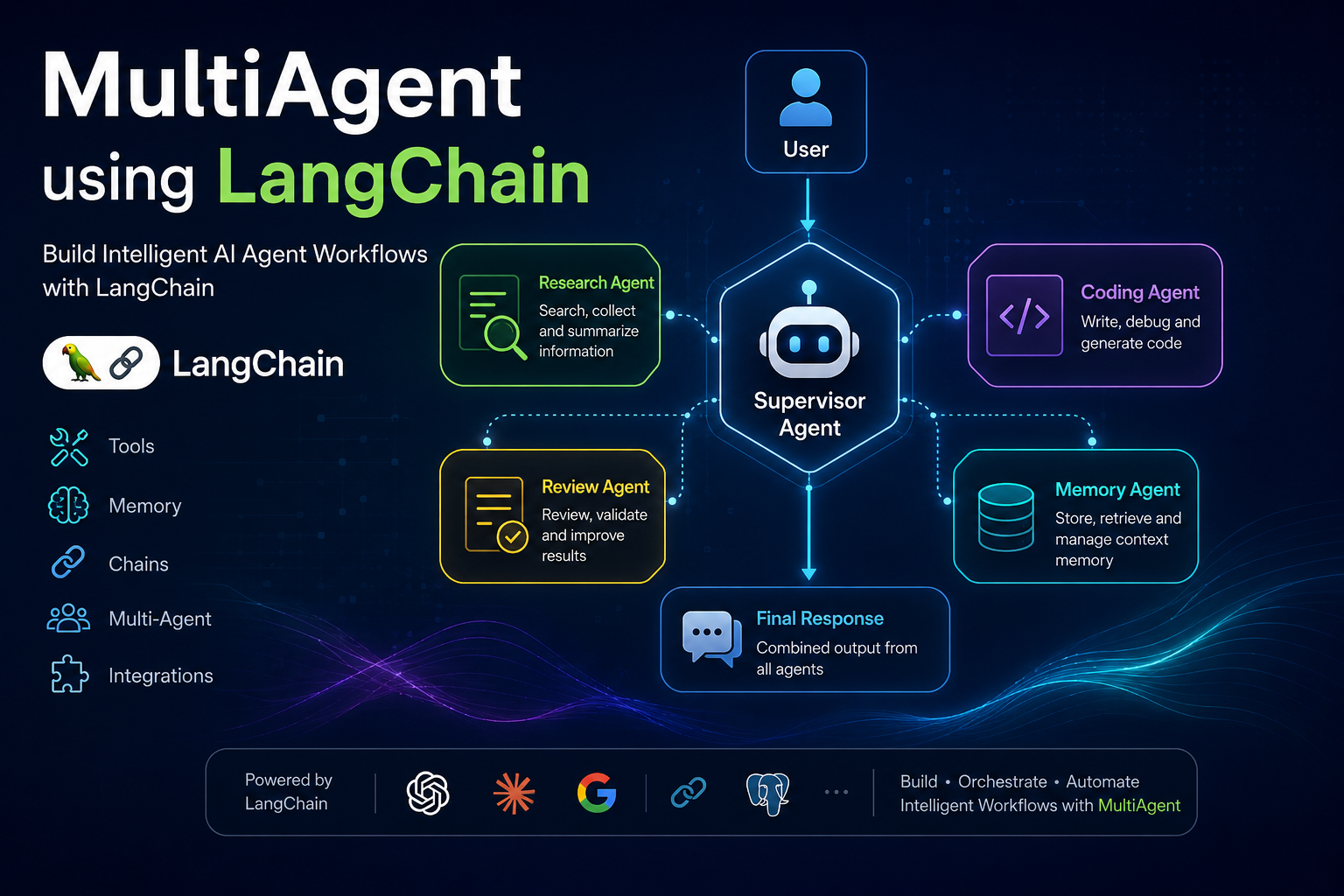
In a typical MultiAgent workflow:
- User gives input
- A supervisor agent analyzes the request
- Tasks are delegated to specialized agents
- Agents use tools if needed
- Results are combined
- Final response is generated
This architecture improves task handling for:
- Research systems
- AI coding assistants
- Autonomous agents
- Workflow automation
- AI SaaS platforms
Architecture of MultiAgent using LangChain
Here is a simplified architecture flow:
                User Input
                     |
                     v
            Supervisor Agent
             /      |      \
            /       |       \
           v        v        v
   Research Agent  Coding Agent  Review Agent
           \         |         /
            \        |        /
                 Final Output
Each agent can independently:
- Think
- Reason
- Use tools
- Call APIs
- Pass outputs
This creates a collaborative AI ecosystem.
LangChain Tools and LangChain Community Tools
What are LangChain Tools?
LangChain tools are external functionalities that agents can use to perform actions.
Examples:
- Search APIs
- Wikipedia tools
- Python execution
- Database queries
- Weather APIs
- File operations
Without tools, LLMs are limited to their training data.
What are LangChain Community Tools?
LangChain Community provides integrations contributed by the open-source community.
These tools help developers connect:
- Google Search
- SerpAPI
- Arxiv
- YouTube
- SQL databases
- GitHub
- Wolfram Alpha
- Web scraping utilities
Community tools significantly extend LangChain capabilities.
Installing Required Packages
Before building a MultiAgent system, install the required libraries.
Installation
pip install langchain
pip install openai
pip install langchain-community
pip install python-dotenv
You may also install additional integrations depending on your project.
How It Works
The MultiAgent workflow generally works as follows:
Step 1: Define LLM
from langchain.chat_models import ChatOpenAI

llm = ChatOpenAI(
    temperature=0.7,
    model="gpt-4"
)
Step 2: Create Tools
from langchain.tools import Tool

def calculator_tool(query):
    return eval(query)

calculator = Tool(
    name="Calculator",
    func=calculator_tool,
    description="Useful for math calculations"
)
Step 3: Create Agents
from langchain.agents import initialize_agent

agent = initialize_agent(
    tools=[calculator],
    llm=llm,
    agent="zero-shot-react-description",
    verbose=True
)
Step 4: Run Agent
response = agent.run("What is 25 * 12?")
print(response)
FAQ – How It Works
Q1. What is an AI Agent?
An AI agent is an intelligent component that can reason, decide, and perform actions.
Q2. Why use multiple agents?
Multiple agents improve specialization and task handling.
Q3. Can agents communicate with each other?
Yes. MultiAgent architectures allow inter-agent communication.
Q4. Is LangChain beginner friendly?
Yes. LangChain simplifies complex AI workflows.
Building a Supervisor Agent
The Supervisor Agent acts like a project manager.
Responsibilities include:
- Understanding user input
- Assigning tasks
- Managing workflow
- Combining results
Example
def supervisor(task):
    if "code" in task:
        return "coding_agent"
    elif "research" in task:
        return "research_agent"
    else:
        return "general_agent"
The supervisor routes tasks intelligently.
How It Works – Supervisor Logic
- User sends request
- Supervisor analyzes intent
- Appropriate agent selected
- Output generated
This architecture reduces confusion and improves accuracy.
FAQ – Supervisor Agent
Q1. Why is a supervisor agent important?
It coordinates all agents efficiently.
Q2. Can we have multiple supervisors?
Yes. Large systems may use hierarchical supervisors.
Q3. Does supervisor use memory?
Yes, depending on implementation.
Creating Specialized Agents
A major advantage of MultiAgent systems is specialization.
Research Agent
def research_agent(query):
    return f"Researching: {query}"
Coding Agent
def coding_agent(task):
    return f"Generating code for: {task}"
Review Agent
def review_agent(output):
    return f"Reviewing: {output}"
Each agent focuses on one responsibility.
How It Works – Specialized Agents
Specialized agents:
- Reduce hallucinations
- Improve reliability
- Enhance workflow quality
Instead of one overloaded agent, tasks are distributed intelligently.
FAQ – Specialized Agents
Q1. Can I create unlimited agents?
Yes, based on system resources.
Q2. Which agent should execute first?
Usually a planner or supervisor agent.
Q3. Are agents independent?
They can be independent or collaborative.
Memory in MultiAgent Systems
Memory helps agents remember:
- Previous tasks
- User context
- Conversation history
- Intermediate outputs
LangChain supports:
- Conversation memory
- Buffer memory
- Vector memory
Example
from langchain.memory import ConversationBufferMemory

memory = ConversationBufferMemory()
Memory is essential for long workflows.
How It Works – Memory Flow
User Input
   |
Memory Stores Context
   |
Agents Access Context
   |
Final Response
This creates continuity in conversations.
FAQ – Memory
Q1. Why is memory important?
Without memory, agents forget context.
Q2. Does memory increase cost?
Yes, longer context increases token usage.
Q3. Can memory use vector databases?
Yes. Many systems use vector storage.
MultiAgent Workflow Example
Suppose a user asks:
“Research AI trading bots and generate a Python script.”
Workflow:
| Step | Agent |
|---|---|
| Analyze request | Supervisor |
| Collect information | Research Agent |
| Write code | Coding Agent |
| Validate script | Review Agent |
| Return output | Final Response |
This demonstrates collaborative AI automation.
Benefits of MultiAgent using LangChain
1. Better Task Management
Each agent focuses on a specific responsibility.
2. Scalability
New agents can be added easily.
3. Cleaner Architecture
Modular design improves maintainability.
4. Advanced Automation
Enables autonomous workflows.
5. Improved Reasoning
Agents collaborate for better results.
Challenges in MultiAgent Systems
Despite advantages, some challenges exist.
1. Agent Coordination
Managing communication can become difficult.
2. Cost
Multiple agents increase token usage.
3. Latency
More agents may increase response time.
4. Complexity
Large systems require better orchestration.
How It Works – Agent Communication
Agents may communicate using:
- Shared memory
- APIs
- Structured outputs
- JSON messaging
Example:
message = {
    "task": "generate_code",
    "status": "pending"
}
Structured communication improves reliability.
FAQ – MultiAgent Communication
Q1. Can agents fail independently?
Yes. Systems should include error handling.
Q2. Can agents use different models?
Yes. Different LLMs can be assigned.
Q3. Is MultiAgent suitable for production?
Yes, many companies are adopting it.
Real-World Applications
MultiAgent systems are used in:
| Industry | Use Case |
|---|---|
| Finance | Trading bots |
| Healthcare | Medical assistants |
| Education | AI tutors |
| Customer Support | Intelligent automation |
| Software Development | AI coding assistants |
| Research | Autonomous research agents |
The future of AI applications is moving toward collaborative agent ecosystems.
Future of MultiAgent Systems
The future of AI development will likely involve:
- Autonomous AI teams
- Self-improving agents
- AI SaaS ecosystems
- Enterprise automation
- AI collaboration frameworks
LangChain is becoming a major framework in this space because of its flexibility and growing ecosystem.
Best Practices for MultiAgent using LangChain
Keep Agents Specialized
Avoid giving one agent too many responsibilities.
Use Structured Outputs
JSON-based communication improves reliability.
Implement Logging
Track agent execution steps.
Optimize Memory Usage
Large memory increases cost.
Add Error Handling
Agents should recover gracefully.
FAQ – Best Practices
Q1. Should beginners start with MultiAgent?
Start with single-agent systems first.
Q2. Is LangChain production-ready?
Yes, but architecture planning is important.
Q3. Are community tools reliable?
Most are useful, but testing is necessary.
Conclusion
MultiAgent using LangChain is transforming how intelligent AI systems are built. Instead of relying on a single AI model, developers can now create collaborative agent ecosystems where specialized agents work together efficiently.
Using LangChain makes it easier to:
- Build scalable AI systems
- Manage tools and memory
- Coordinate intelligent workflows
- Create autonomous AI applications
This project demonstrates how LangChain can orchestrate multiple agents into a unified chain-based architecture. The combination of MultiAgent, LangChain Tools, and LangChain Community Tools opens endless possibilities for AI developers.
As AI continues evolving, MultiAgent architectures will become increasingly important in building next-generation intelligent systems.
Final FAQ
Q1. What is MultiAgent using LangChain?
It is an AI architecture where multiple intelligent agents collaborate using LangChain workflows.
Q2. Why use LangChain for MultiAgent projects?
LangChain simplifies agent orchestration, tool usage, memory, and workflow management.
Q3. What are LangChain Community Tools?
They are open-source integrations contributed by the LangChain community.
Q4. Can MultiAgent systems build SaaS products?
Yes. Many AI SaaS platforms use MultiAgent workflows.
Q5. Is this architecture suitable for AI trading bots?
Yes. MultiAgent systems are highly useful for automated trading workflows.
If you are interested in this article or want to collaborate, feel free to get in touch. I am available in Contact Us.
Thank you for reading.
Published by TechToGeek.com