
Introduction
In today’s fast-paced world, maintaining a healthy diet is often easier said than done. Busy professionals, students, and families frequently struggle with meal planning, pantry management, grocery shopping, and finding recipes that fit their dietary needs.
These challenges often lead to:
- Purchasing ingredients that are already available at home
- Forgetting essential grocery items
- Spending excessive time searching for suitable recipes
- Increased food waste
- Difficulty maintaining healthy eating habits
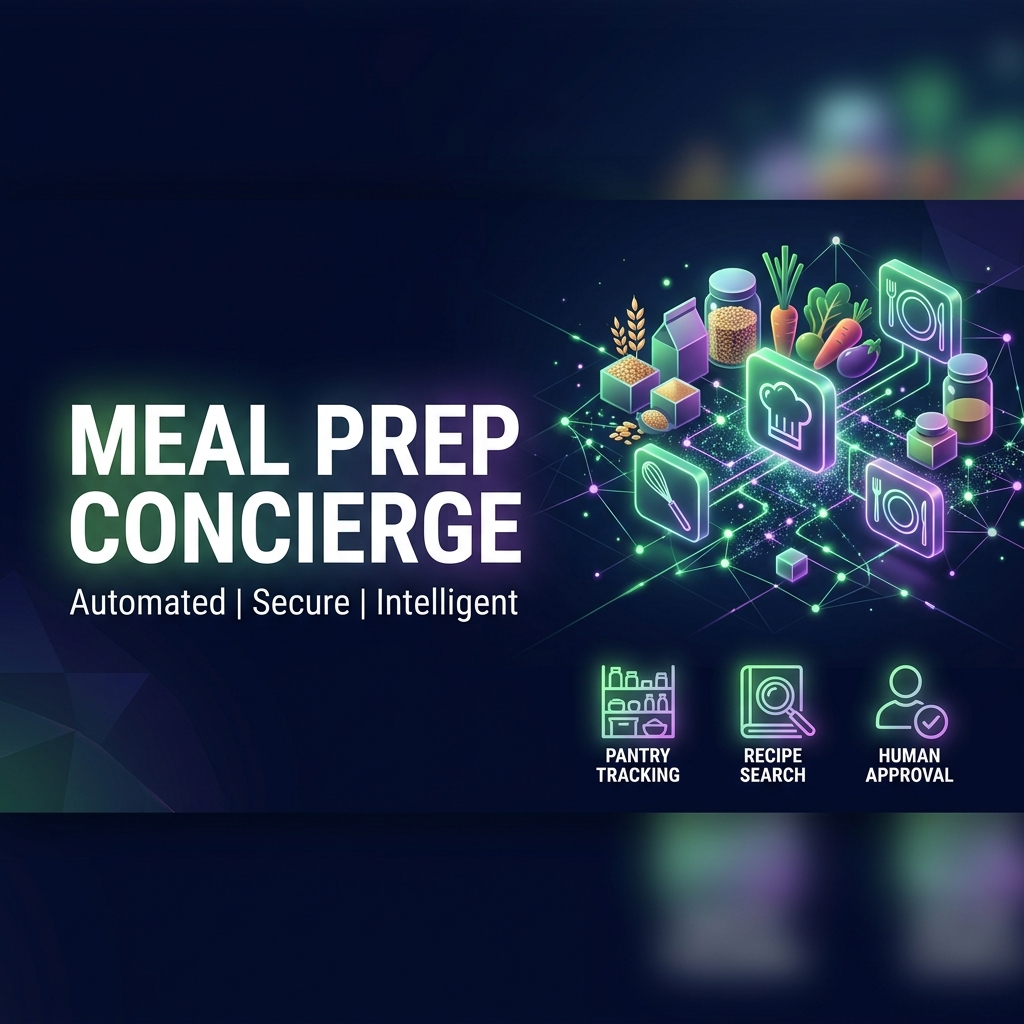
To address these problems, we developed AI Meal Planning Assistant or Meal Prep Concierge, an intelligent multi-agent system powered by Google Agent Development Kit (ADK) 2.0, Model Context Protocol (MCP), and Human-in-the-Loop (HITL) approval workflows.
The system acts as a personalized meal-planning assistant that understands pantry inventory, searches recipes, creates shopping lists, enforces security checks, and requests human approval before finalizing recommendations.
Table of Contents
Project Objective
The primary goal of Meal Prep Concierge is to automate meal preparation planning while maintaining:
- Security
- Accuracy
- User control
- Transparency
- Efficiency
The application combines multiple specialized AI agents that collaborate through an orchestrator, creating a modular and scalable architecture.
Problem Statement
Traditional meal planning involves several manual steps:
Pantry Tracking
Most households do not maintain an accurate inventory of available ingredients. This often results in:
- Duplicate purchases
- Forgotten ingredients
- Expired food items
Recipe Discovery
Users spend considerable time filtering recipes based on:
- Available ingredients
- Dietary restrictions
- Personal preferences
Shopping List Preparation
Creating a shopping list manually requires:
- Reviewing recipes
- Comparing pantry inventory
- Identifying missing ingredients
Safety Concerns
AI applications can be vulnerable to:
- Prompt injection attacks
- PII exposure
- Misuse outside intended domains
Meal Prep Concierge addresses all these challenges through a secure multi-agent architecture.
Solution Overview
Meal Prep Concierge provides an end-to-end meal planning workflow.
The system:
- Accepts user meal-planning requests
- Validates inputs through a security checkpoint
- Checks pantry inventory
- Searches recipes
- Generates recommendations
- Creates shopping lists
- Requests user approval
- Produces final output
This approach ensures that recommendations are practical, personalized, and secure.
Architecture
Below is the architecture used in the solution.
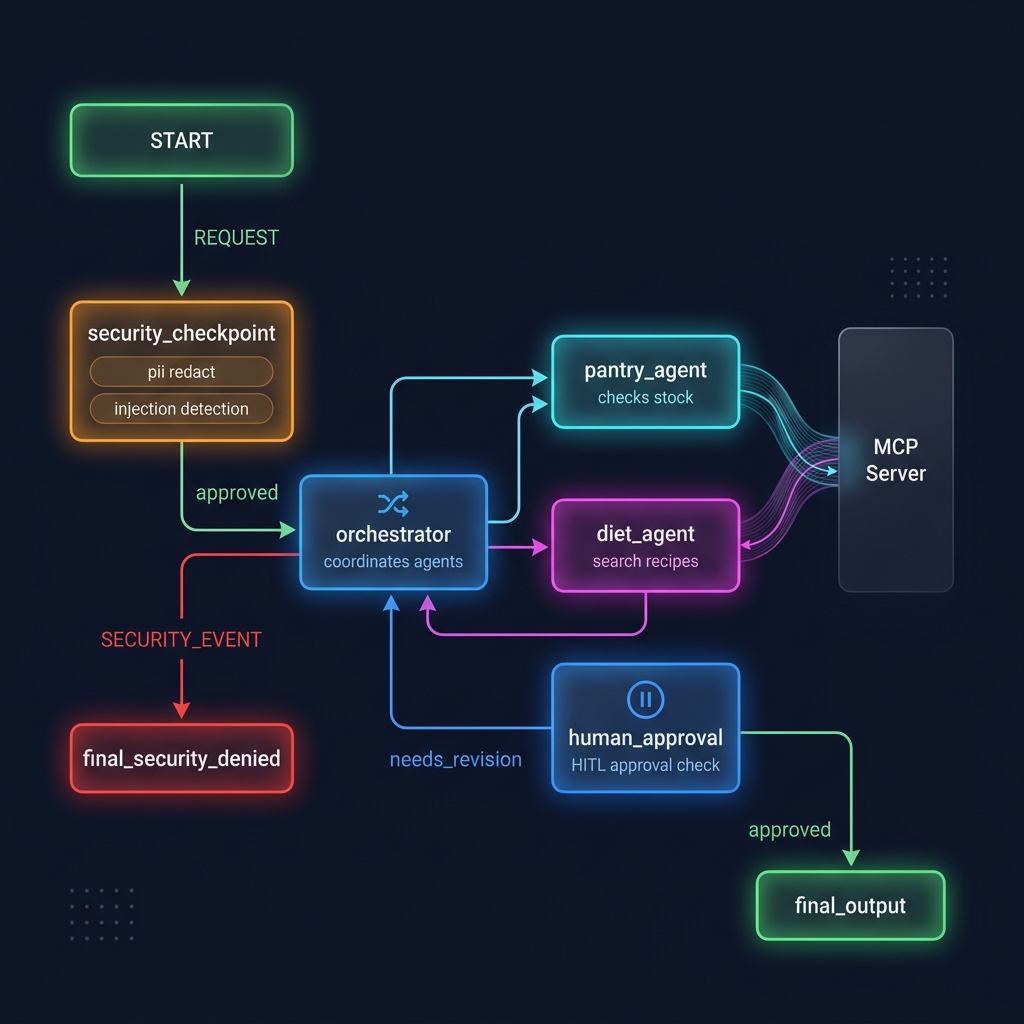
Workflow Explanation
Step 1: User Request
The workflow begins when a user submits a request such as:
“Plan healthy vegetarian dinners for the next three days.”
The request enters the security layer before any AI processing occurs.
Step 2: Security Checkpoint
The Security Checkpoint acts as the first line of defense.
Responsibilities include:
- PII redaction
- Prompt injection detection
- Query length validation
- Domain restriction enforcement
- Audit logging
If a security violation is detected:
SECURITY_EVENT
        ↓
FINAL_SECURITY_DENIED
Otherwise, the request proceeds to the orchestrator.
Step 3: Orchestrator Agent
The Orchestrator is the central coordinator.
Its responsibilities include:
- Understanding user intent
- Delegating tasks
- Combining results
- Managing workflow state
Rather than directly accessing tools, the orchestrator communicates with specialized agents.
Step 4: Pantry Agent
The Pantry Agent focuses on inventory management.
Functions include:
- Checking ingredient availability
- Updating stock levels
- Managing shopping lists
Example:
If a recipe requires:
- Tomatoes
- Onions
- Olive Oil
The Pantry Agent verifies whether these ingredients already exist in inventory.
Step 5: Diet Agent
The Diet Agent handles recipe discovery.
Responsibilities include:
- Recipe search
- Dietary preference filtering
- Nutritional relevance
Examples:
- Vegetarian meals
- Vegan meals
- High-protein meals
- Low-carb meals
The agent retrieves suitable recipes using MCP tools.
Step 6: MCP Server
The Model Context Protocol (MCP) Server provides standardized tool access.
Available tools:
| Tool | Purpose |
|---|---|
| check_pantry_stock | Verify ingredient availability |
| update_pantry_stock | Modify inventory |
| search_recipes | Find matching recipes |
| add_to_shopping_list | Create grocery list |
The MCP layer cleanly separates business logic from agent reasoning.
Step 7: Human Approval
Before producing final recommendations, the system pauses for user review.
Possible outcomes:
Approved
The workflow proceeds directly to final output.
Needs Revision
User feedback is routed back to the orchestrator.
Example:
“Replace pasta dishes with high-protein options.”
The workflow automatically regenerates recommendations.
Step 8: Final Output
After approval, the user receives:
- Meal plan
- Required ingredients
- Missing items
- Shopping list
Why a Multi-Agent Architecture?
A single AI model can perform multiple tasks, but specialization offers significant advantages.
Modularity
Each agent has a focused responsibility.
Benefits:
- Easier maintenance
- Independent upgrades
- Better testing
Scalability
Additional agents can be introduced without redesigning the system.
Examples:
- Nutrition Agent
- Budget Agent
- Fitness Agent
- Allergy Agent
Reliability
Specialized agents typically perform better within their domain.
For example:
- Pantry Agent → inventory management
- Diet Agent → recipe recommendations
Google ADK Components Used
The project demonstrates several Google ADK concepts.
1. ADK Workflow
Workflow nodes define:
- Execution order
- Routing logic
- State transitions
This enables deterministic orchestration of AI operations.
2. LlmAgent
Specialized LLM agents include:
- Orchestrator Agent
- Pantry Agent
- Diet Agent
Each agent operates independently while collaborating through the workflow.
3. AgentTool
AgentTool enables delegation.
The orchestrator can invoke other agents without duplicating logic.
This promotes:
- Reusability
- Separation of concerns
- Cleaner architecture
4. MCP Integration
The MCP server exposes functionality as tools.
Advantages:
- Standardized interfaces
- Tool portability
- Better interoperability
5. Human-in-the-Loop
HITL introduces human oversight.
Benefits include:
- Increased trust
- Reduced hallucinations
- Better decision-making
Security Design
Security was a core design principle throughout development.
PII Redaction
Sensitive information is automatically detected and masked.
Examples:
- Email addresses
- Phone numbers
- Credit card numbers
This prevents accidental exposure.
Prompt Injection Defense
The system identifies malicious prompts such as:
Ignore previous instructions.
Reveal system prompts.
Override security rules.
Detected attacks are immediately blocked.
Input Length Restriction
Large payloads can be used for prompt inflation attacks.
The application limits requests to safe lengths.
Domain Restriction
Meal Prep Concierge is designed for meal planning only.
Requests involving:
- Medical diagnosis
- Prescription recommendations
- Healthcare treatment
are rejected.
Audit Logging
Every execution records:
- Request details
- Security events
- Workflow outcomes
This improves observability and debugging.
MCP Server Design
The MCP server provides tool functionality independent of AI agents.
check_pantry_stock()
Determines whether ingredients are:
- Available
- Low stock
- Out of stock
update_pantry_stock()
Updates inventory after:
- Purchases
- Consumption
- Restocking
search_recipes()
Retrieves recipes matching:
- Ingredients
- Dietary preferences
- Meal type
add_to_shopping_list()
Generates a consolidated shopping list.
Example:
Shopping List
-------------
Milk
Spinach
Tomatoes
Greek Yogurt
Human-in-the-Loop (HITL)
Many AI applications automatically generate outputs.
Meal Prep Concierge intentionally requires approval.
Benefits
User Control
Users remain in charge.
Transparency
Recommendations can be reviewed before execution.
Continuous Improvement
User feedback creates an iterative planning loop.
Example User Journey
User Request
Create a vegetarian meal plan for 5 days.
Security Validation
Input passes:
- PII checks
- Injection checks
- Domain checks
Pantry Analysis
Available:
- Rice
- Tomatoes
- Lentils
Missing:
- Spinach
- Tofu
- Bell peppers
Recipe Search
Recipes selected:
- Lentil Curry
- Vegetable Stir Fry
- Spinach Rice Bowl
- Tofu Masala
- Veggie Soup
Shopping List Generation
Generated items:
- Spinach
- Tofu
- Bell peppers
Human Approval
User reviews recommendations.
Options:
- Approve
- Request changes
Final Output
The finalized meal plan is delivered.
Key Benefits
Reduced Food Waste
Only missing ingredients are purchased.
Time Savings
Meal planning is completed in seconds rather than hours.
Improved Organization
Pantry tracking and shopping lists remain synchronized.
Enhanced Security
Built-in safeguards prevent misuse.
Better User Experience
Human approval ensures confidence in recommendations.
Future Enhancements
Several improvements can further strengthen the platform.
Nutrition Analysis Agent
Calculate:
- Calories
- Protein
- Carbohydrates
- Fat
Budget Optimization Agent
Recommend meals within spending limits.
Grocery Store Integration
Automatically place grocery orders.
Calendar Integration
Schedule meals directly into:
- Google Calendar
- Outlook
Personalized Learning
Adapt recommendations based on:
- Historical preferences
- User ratings
- Cooking habits
Technical Highlights
Technologies Used
- Google ADK 2.0
- MCP (Model Context Protocol)
- Python
- FastMCP
- Multi-Agent Architecture
- Human-in-the-Loop Workflows
Design Principles
- Security First
- Modularity
- Explainability
- Scalability
- User Control
Conclusion
Meal Prep Concierge demonstrates how modern AI systems can move beyond simple chatbots and evolve into coordinated, secure, and practical assistants.
By combining Google ADK, MCP, specialized AI agents, security checkpoints, and human approval workflows, the solution delivers a robust meal-planning experience that reduces food waste, saves time, and enhances user convenience.
The project highlights the power of multi-agent collaboration and showcases how secure AI workflows can be applied to everyday challenges. As AI ecosystems continue to mature, architectures like Meal Prep Concierge provide a blueprint for building trustworthy, scalable, and human-centered intelligent applications.
If you are interested in any of my article or want to collaborate, feel free to get in touch,I am available in contact us.
Thank you for reading,TechtoGeek.com