
Introduction
In today’s fast-paced business environment, workforce scheduling has become one of the most challenging operational tasks. Organizations across industries—including healthcare, customer support, manufacturing, retail, logistics, and offshore engineering—struggle to create employee schedules that balance operational demands, compliance requirements, employee preferences, and organizational efficiency.
Traditional scheduling methods often rely on spreadsheets, manual planning, and human judgment. While these approaches may work for small teams, they become increasingly inefficient as workforce size grows and scheduling constraints become more complex.
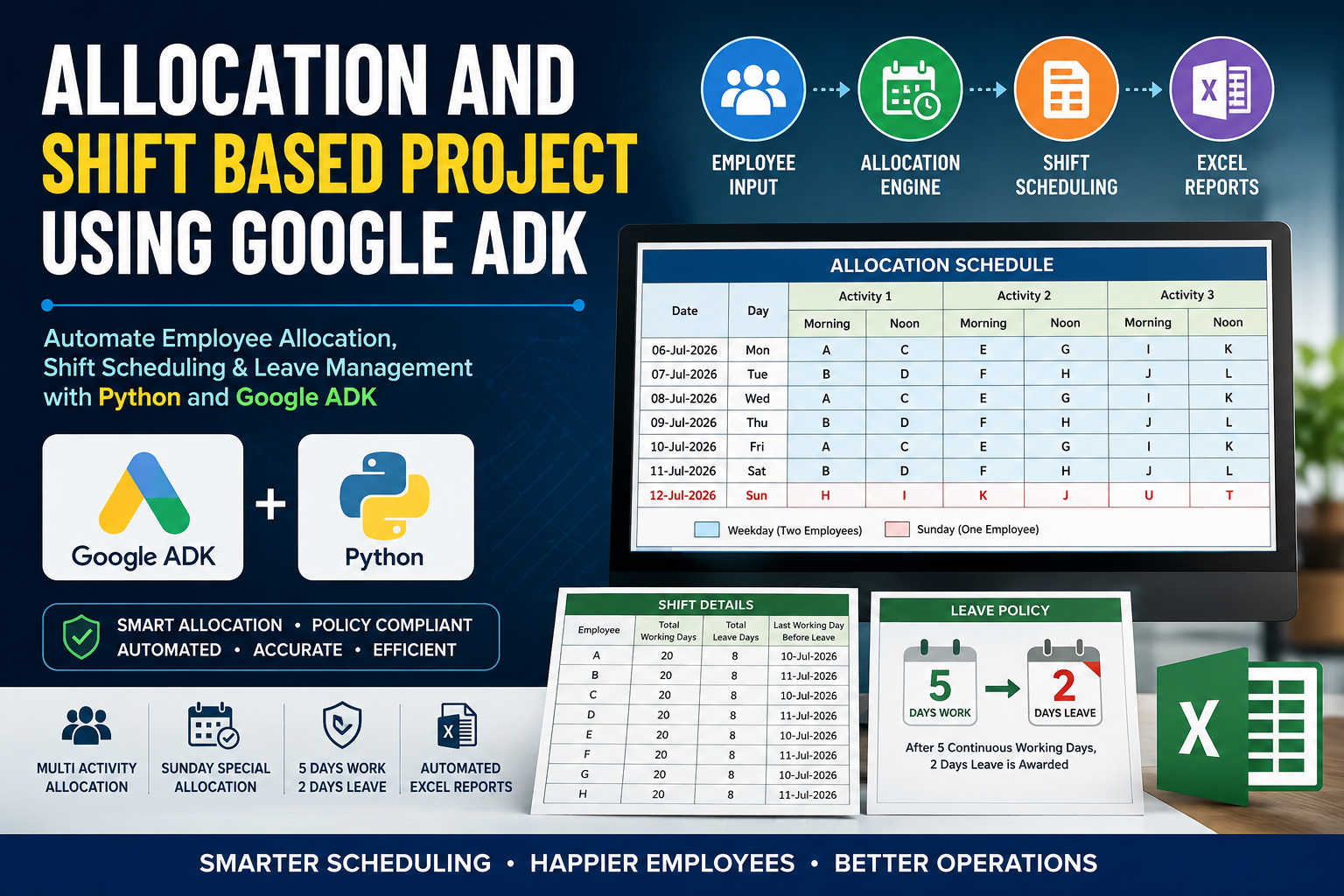
This is where SmartRoster, a next-generation Shift Planner and Auto-Scheduler, transforms workforce management.
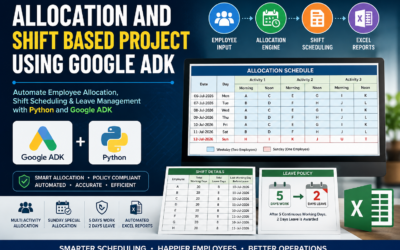
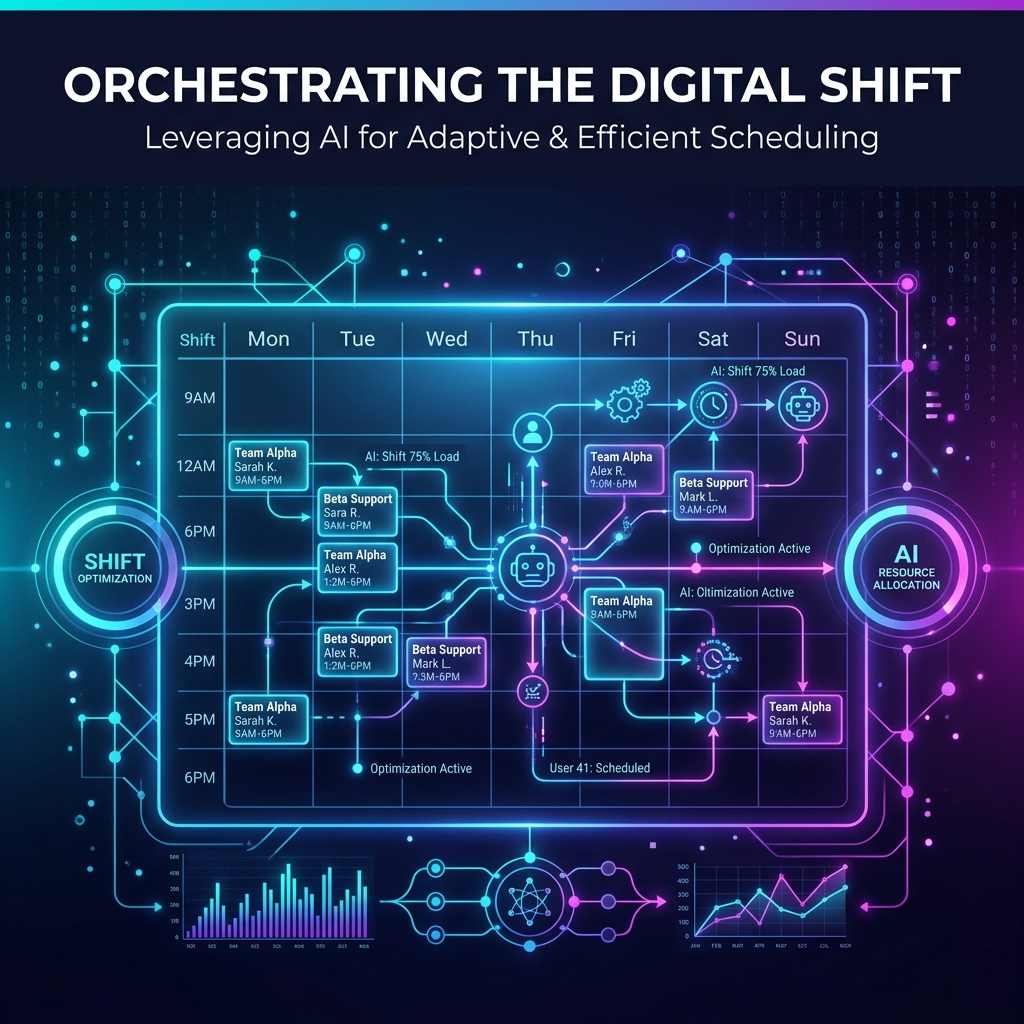
Powered by Google Agent Development Kit (ADK) and advanced AI orchestration capabilities, SmartRoster combines the precision of deterministic scheduling algorithms with the intelligence of AI agents to create optimized, fair, and compliant schedules automatically.
Table of Contents
What is SmartRoster?
SmartRoster is an intelligent workforce scheduling platform that automates shift planning through a hybrid architecture that combines:
- Deterministic scheduling algorithms
- Constraint satisfaction solvers
- Google ADK agent orchestration
- Gemini-powered intelligence
- Automated schedule generation
- Google Sheets integration
- Excel-based fallback capabilities
Unlike conventional scheduling software that depends entirely on predefined rules or purely AI-generated outputs, SmartRoster leverages the best of both worlds.
The result is an enterprise-grade Shift Planner that ensures accuracy, compliance, fairness, and automation.
The Challenge: Multi-Dimensional Constraints
The system was designed to schedule shifts for an offshore team under the following strict operational rules:
- Shift Timings: Support for two overlapping shifts in IST:
Shift 1 (07:00 - 15:00)andShift 2 (12:00 - 20:00). - Work-Life Balance: Every employee must receive exactly two off-days (weekoffs) per week.
- Sunday Standby: On Sundays, coverage needs to drop to exactly one employee per shift (1 in Shift 1, 1 in Shift 2) to maintain essential operations, while the rest of the team remains off.
- Balanced Weekdays: Weekday shifts must be distributed as evenly as possible across the team to prevent burnout and ensure fair utilization.
Why Traditional Shift Planning Fails
Many organizations still use:
- Excel spreadsheets
- Manual roster creation
- Static scheduling systems
- Manager-dependent planning
These approaches introduce several challenges:
Human Errors
Managers may accidentally:
- Over-allocate shifts
- Miss employee week-offs
- Violate labor regulations
- Create uneven workloads
Scalability Problems
As team sizes increase:
- Complexity grows exponentially
- Schedule creation takes longer
- Errors become more frequent
Fairness Concerns
Manual scheduling often results in:
- Uneven shift distribution
- Employee dissatisfaction
- Increased burnout
Compliance Risks
Organizations must comply with:
- Labor laws
- Working hour regulations
- Mandatory rest periods
- Industry-specific requirements
Traditional tools frequently struggle to enforce these constraints consistently.
The SmartRoster Solution
SmartRoster addresses these challenges through intelligent automation.
Its architecture is built around three primary components:
- Deterministic Scheduling Engine
- Google ADK Agent Layer
- Integration & Reporting Framework
Together, these components create a highly reliable Shift Planner and Auto-Scheduler.
Understanding the SmartRoster Architecture
High-Level System Architecture
A clean, modular architecture was selected to separate the cognitive interface from the algorithmic execution and integration boundaries:
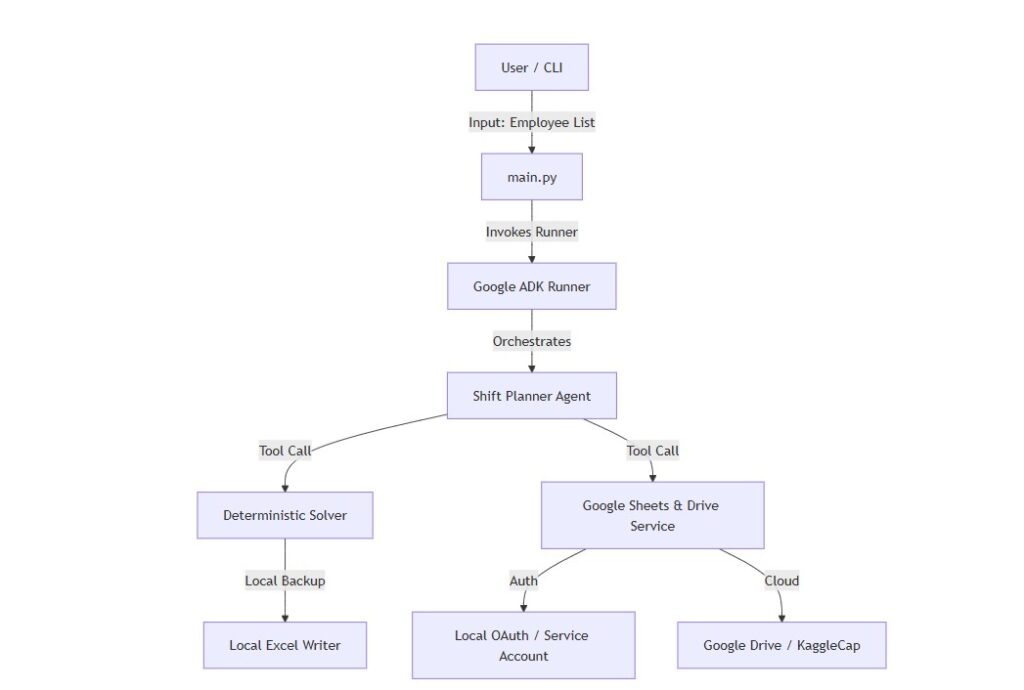
The SmartRoster platform follows a modular architecture that separates:
- Scheduling logic
- AI orchestration
- Integration services
This design improves:
- Maintainability
- Scalability
- Reliability
- Extensibility
The architecture includes:
User Interface Layer
Receives:
- Employee lists
- Shift requirements
- Scheduling preferences
Google ADK Agent Layer
Coordinates:
- Workflow execution
- Tool calling
- Decision orchestration
Scheduling Engine
Handles:
- Constraint satisfaction
- Shift assignment
- Optimization
Integration Layer
Manages:
- Google Sheets
- Google Drive
- Excel exports
- Reporting
Core Scheduling Challenges Solved by SmartRoster
Workforce scheduling is fundamentally a Constraint Satisfaction Problem (CSP).
SmartRoster is designed to solve multiple constraints simultaneously.
Shift Coverage Requirements
Organizations often require:
- Multiple shifts
- Continuous coverage
- Specific staffing levels
SmartRoster ensures:
- Every shift is covered
- Staffing levels are maintained
- Operational requirements are met
Week-Off Management
Employees require:
- Weekly rest days
- Work-life balance
- Compliance with labor regulations
SmartRoster automatically allocates:
- Mandatory week-offs
- Balanced off-day distribution
- Fair scheduling patterns
Sunday Standby Scheduling
Many operations require:
- Reduced staffing
- Emergency support
- Minimal coverage
SmartRoster intelligently:
- Assigns standby personnel
- Maintains essential operations
- Maximizes employee rest
Fair Workload Distribution
Unequal scheduling creates:
- Employee dissatisfaction
- Fatigue
- Reduced productivity
SmartRoster ensures:
- Fair shift allocation
- Balanced workloads
- Rotational scheduling
The Deterministic Scheduling Engine
At the heart of SmartRoster lies a deterministic scheduling engine.
This engine is responsible for:
- Schedule generation
- Constraint validation
- Coverage optimization
Unlike AI-generated schedules, deterministic algorithms provide:
- Predictability
- Consistency
- Mathematical correctness
Why Deterministic Scheduling Matters
Large Language Models excel at:
- Language understanding
- Summarization
- Communication
However, scheduling requires:
- Precise calculations
- Rule enforcement
- Constraint validation
A purely AI-generated schedule may:
- Miss week-offs
- Double-book employees
- Violate regulations
SmartRoster avoids these risks by using deterministic algorithms.
Constraint Satisfaction Approach
The scheduling engine models workforce planning as a CSP.
Each scheduling decision must satisfy:
- Employee availability
- Shift requirements
- Work-hour limitations
- Week-off rules
The engine evaluates:
- Valid assignments
- Constraint compliance
- Optimization opportunities
This ensures every generated schedule is valid.
Google ADK Integration
One of SmartRoster’s most powerful features is its integration with Google’s Agent Development Kit (ADK).
Google ADK provides:
- Agent orchestration
- Tool execution
- Workflow automation
This transforms SmartRoster into an intelligent scheduling assistant.
What is Google ADK?
Google ADK is a framework designed for building AI agents capable of:
- Tool usage
- Task execution
- Multi-step reasoning
- Workflow automation
In SmartRoster, Google ADK acts as the orchestration layer.
How Google ADK Enhances SmartRoster
The ADK-powered agent can:
- Understand scheduling requests
- Trigger schedule generation
- Execute scheduling tools
- Generate reports
- Explain scheduling decisions
This creates a conversational and intelligent scheduling experience.
Gemini-Powered Scheduling Intelligence
SmartRoster leverages Google’s Gemini models for:
- Schedule explanations
- Workforce insights
- User interaction
- Natural language reporting
Gemini does not generate schedules directly.
Instead, it enhances usability through intelligent communication.
Hybrid AI Architecture
A key innovation of SmartRoster is its hybrid AI approach.
The platform separates:
Deterministic Tasks
Handled by algorithms:
- Scheduling
- Validation
- Constraint enforcement
Cognitive Tasks
Handled by AI:
- Explanations
- Summaries
- Recommendations
- Insights
This architecture maximizes both accuracy and intelligence.
Benefits of the Hybrid Model
Organizations gain:
- Reliable schedules
- AI-powered assistance
- Reduced errors
- Greater trust
The result is an enterprise-ready scheduling solution.
Automated Shift Planning
SmartRoster automates every stage of shift planning.
Employee Input
Managers provide:
- Employee lists
- Availability
- Constraints
Schedule Generation
The engine creates:
- Optimized rosters
- Balanced assignments
- Valid schedules
Validation
Every schedule undergoes:
- Rule checking
- Compliance verification
- Constraint validation
Publishing
Schedules are automatically shared.
Smart Auto-Scheduler Features
Intelligent Shift Assignment
Employees are assigned shifts based on:
- Availability
- Workload balance
- Scheduling rules
Automatic Week-Off Allocation
The system ensures:
- Consistent rest periods
- Fair off-day distribution
Conflict Detection
SmartRoster identifies:
- Scheduling conflicts
- Coverage gaps
- Compliance issues
Before publishing.
Dynamic Optimization
Schedules are continuously optimized for:
- Fairness
- Efficiency
- Operational needs
Google Sheets Integration
Many organizations rely on Google Sheets.
SmartRoster integrates seamlessly with:
- Google Sheets
- Google Drive
- Cloud-based collaboration
Benefits include:
- Real-time access
- Easy sharing
- Version control
Automated Spreadsheet Creation
The system can automatically:
- Create spreadsheets
- Populate schedules
- Update rosters
- Share reports
This eliminates manual data entry.
Excel Fallback Capability
Not every environment supports cloud integrations.
SmartRoster includes a robust Excel fallback mechanism.
Features include:
- Local file generation
- Professional formatting
- Conditional styling
- Offline access
Enterprise Reliability
Business-critical systems require resilience.
SmartRoster ensures reliability through:
- Fallback mechanisms
- Error handling
- Local execution support
Organizations can continue scheduling even during cloud outages.
Workforce Optimization Benefits
Organizations using SmartRoster experience:
Improved Productivity
Managers spend less time:
- Creating schedules
- Fixing errors
- Managing conflicts
Reduced Costs
Automation reduces:
- Administrative effort
- Overtime costs
- Scheduling inefficiencies
Better Employee Satisfaction
Fair scheduling improves:
- Morale
- Retention
- Engagement
Compliance Assurance
Automated rule enforcement minimizes compliance risks.
Industry Applications
Healthcare
Manage:
- Nurses
- Doctors
- Technicians
Retail
Schedule:
- Store associates
- Cashiers
- Supervisors
Manufacturing
Coordinate:
- Production teams
- Maintenance crews
Logistics
Allocate:
- Drivers
- Warehouse workers
Customer Support
Plan:
- Support engineers
- Call center agents
Offshore Engineering
Optimize:
- Shift-based operations
- Critical support coverage
SmartRoster for Offshore Teams
Offshore engineering operations often require:
- Continuous coverage
- Multiple time zones
- Strict scheduling
SmartRoster excels in these environments.
The platform ensures:
- Consistent support
- Balanced workloads
- Fair shift rotations
Advanced Scheduling Intelligence
Future versions of SmartRoster can support:
Predictive Scheduling
Using historical data to forecast:
- Staffing needs
- Demand spikes
Employee Preference Learning
Learning:
- Preferred shifts
- Availability patterns
AI Recommendations
Suggesting:
- Workforce adjustments
- Scheduling improvements
Security and Governance
Enterprise deployments require:
- Data security
- Access controls
- Auditability
SmartRoster supports:
- Role-based permissions
- Secure integrations
- Audit trails
Scalability
SmartRoster is designed to scale from:
- Small teams
- Mid-sized organizations
- Large enterprises
The architecture supports thousands of employees efficiently.
Why Choose SmartRoster?
Organizations choose SmartRoster because it provides:
✓ Automated scheduling
✓ Fair shift allocation
✓ Google ADK integration
✓ AI-powered insights
✓ Compliance enforcement
✓ Cloud and local support
✓ Enterprise scalability
✓ Workforce optimization
✓ Reduced administrative burden
✓ Improved employee satisfaction
Future Roadmap
Planned enhancements include:
- Multi-location scheduling
- Leave management integration
- Workforce forecasting
- Mobile applications
- Real-time notifications
- AI-based staffing recommendations
- HRMS integration
- Payroll synchronization
- Predictive workforce analytics
- Advanced reporting dashboards
Conclusion
SmartRoster represents the future of intelligent workforce scheduling. By combining deterministic scheduling algorithms with Google ADK-powered AI orchestration, it delivers a powerful, accurate, and scalable Shift Planner and Auto-Scheduler.
Unlike traditional scheduling tools that rely heavily on manual effort or purely AI-generated outputs, SmartRoster uses a hybrid architecture that guarantees operational correctness while providing intelligent assistance through Google Gemini and ADK.
Whether managing offshore engineering teams, healthcare professionals, retail workers, manufacturing staff, or customer support operations, SmartRoster ensures that schedules are fair, compliant, balanced, and optimized.
As organizations continue embracing AI-powered workforce management, SmartRoster stands out as a next-generation scheduling platform capable of transforming how teams are planned, managed, and optimized.
SmartRoster is not just a Shift Planner—it is an intelligent workforce scheduling ecosystem built for the future.
By isolating constraints inside a robust Python solver and leveraging Google ADK’s tool execution framework, we built a shift planner that is both computationally correct and naturally interactive.
The code has been pushed to a remote GitHub repository at https://github.com/subasen85/ShiftPlanner, demonstrating how clean software design patterns can pave the way for successful AI agent integrations.
If you are interested in any of my article or want to collaborate, feel free to get in touch,I am available in contact us.
Thank you for reading,TechtoGeek.com